Tummy tuck recovery: what to expect, week by week

After a full tummy tuck, most people are back at a desk job after two to three weeks and walk more upright by three to four weeks, with posture nearly normal by six. You stick to walking for six weeks, or three months if your muscles were repaired, which is usual with a full tummy tuck. After a mini tummy tuck, desk work is usually possible after one to two weeks. The swelling takes three to six months to settle, and the final result shows at about six months.
The first two weeks are the hardest part. Most people find each week easier than the last after that. How quickly you recover depends mainly on two things: whether you have a mini or a full tummy tuck, and whether your surgeon also repaired your stomach muscles. A mini tummy tuck leaves no scar around the belly button, the skin above the scar is not lifted off the tummy wall, and the muscles are not tightened, which is why recovery is quicker. A full tummy tuck usually includes a repair, and a repair adds months to the return to exercise, so ask at your consultation whether you need one.
The timings here are what most of our patients find. Your surgeon may adjust them for you, and their instructions come first.
What does tummy tuck recovery look like at a glance?
Day of surgery
Mini: home the same day. Full: one night in hospital
Days 1 to 7
Sore, swollen and bent forward
End of week 1
Your first nurse appointment
Week 2
Standing a little straighter
Weeks 3 to 4
Walking upright again
Week 6
Nearly normal posture
3 to 6 months
The swelling settles and the result shows
What happens week by week?
The day of surgery
A mini tummy tuck is day surgery, so you go home the same day. A full tummy tuck takes about two hours under general anaesthetic and involves one night at our partner hospital, with the same consultant looking after you. Your surgeon tells you at the consultation which operation you need.
Your nurse fits compression stockings before you leave, and they help prevent blood clots. You go home with your painkillers, each labelled with its dose, and a card with your nurse appointment and our contact numbers. Your nurse goes through each medicine with you first. Someone needs to take you home, and a responsible adult must stay with you for your first night at home. We rarely use drains.
Days 1 to 3
The pain is significant for the first few days, especially when you move. Expect tightness, swelling and bruising, often most at the sides, and a few spots of blood on the dressings. You will walk bent forward at the waist. That is your body protecting the repair, so do not force yourself straight.
Take your painkillers regularly, as the labels say, without waiting for the pain to build. A cold pack on your tummy, over your clothing or garment, helps in the first 48 hours. Get up and walk around your home every two to three hours, because walking lowers the risk of a clot. Many people sleep best propped up on a couple of pillows, or in a recliner.
To get out of bed, roll onto your side, push up with your arms and swing your legs down, then stand slowly, staying bent. You can shower carefully from day one, and it does not matter if the outer dressings get wet. Pat yourself dry.
Days 4 to 7
The pain becomes more manageable and you have a little more energy each day. You are still bent forward. The swelling peaks in this first week and then levels off. Keep walking a bit further each day, keep the stockings on, and clean your belly button once a day if it was moved.
At the end of the first week, usually between day 7 and day 10, you see our nurses. They remove the outer dressings, check the wounds and take out any belly button stitches. The paper tape or glue along the scar stays on.
Week 2
You start to stand a little straighter, the pain eases a lot and the bruising begins to fade, though your tummy is still very swollen. Take the paper tape off at the end of week two. If it sticks, a little petroleum jelly loosens it. Glue tape stays on until week three.
After a mini tummy tuck most people are back at a desk job between one and two weeks. After a full tummy tuck, some people manage desk work at the end of week two.
Weeks 3 and 4
By weeks three and four you walk more upright each day, most of the bruising has gone and you feel more like yourself. Most people stop the stockings at about three weeks, once they are fully mobile. Loose clothes are most comfortable for the first three to four weeks.
How long you stay bent depends on what was done. Without a muscle repair, most people stand straighter by two to three weeks. If your muscles were tightened, it takes three to four weeks or longer.
Six weeks
Your posture is nearly normal and the bruising has gone. After a mini tummy tuck you can usually build up to full exercise from here, including gentle core work. After a full tummy tuck with a muscle repair, which is the usual case, you keep to walking until three months. Without a repair, light exercise can start now. Check with us before you start.
Three to six months
About half the swelling has gone by one month and most of it by three. Your tummy may feel hard and look more swollen in the evening. It looks its best in the morning, and that is the better guide. The final result shows at about six months. Numbness below the belly button usually improves over 12 to 18 months, though it may not recover completely.
When can I go back to work, drive, exercise and fly?
Mini tummy tuck
- Desk work
- 1 to 2 weeks
- Driving
- 1 to 2 weeks, once off strong painkillers
- Physical work
- 2 to 3 weeks, with no heavy lifting
- Light exercise
- 4 weeks
- Full exercise
- 6 weeks, building up gradually
- Heavy lifting
- Build up from 6 weeks; heavier lifting from about 3 months
- Core work
- Gentle core work from 6 weeks, building up
- Swimming and hot tubs
- About 6 weeks, once healed
- Flights under 3 hours
- 2 weeks
- Longer flights
- 3 to 4 weeks
Full tummy tuck
- Desk work
- 2 to 3 weeks
- Driving
- 2 to 3 weeks, once off strong painkillers
- Physical work
- 6 to 8 weeks
- Light exercise
- 6 weeks without a muscle repair; 3 months after one
- Full exercise
- 3 months, or 6 months after a muscle repair
- Heavy lifting
- Build up from 6 weeks; heavier lifting from about 3 months, longer after a muscle repair
- Core work
- Gentle core work from about 3 months after a muscle repair, building up
- Swimming and hot tubs
- About 3 months
- Flights under 3 hours
- 2 weeks
- Longer flights
- 3 to 4 weeks
Before you drive, be sure you can do an emergency stop comfortably and are no longer taking strong painkillers. On longer flights, move around regularly and wear flight socks.
Most full tummy tucks include a muscle repair. After one, you stick to walking until three months, then start light exercise and gentle core work, building up to full exercise by about six months. Without a muscle repair, most people start light cardio and gentle core work at six weeks, gentle gym work at eight weeks and everything else at three months, building up gradually. Everyone is different, so take these as a guide.
The same timings as a chart:
When exercise returns after a tummy tuck
Most full tummy tucks include a muscle repair. Check with us before you start each stage.
Tummy tuck aftercare: how do I look after myself at home?
Belly button care
After a full tummy tuck your belly button is moved, and it needs cleaning every day. Use a cotton bud and warm soapy water, gently lift away any crusting, and pat it dry. Call us if redness is spreading, if there is a smelly discharge, or if the pain is getting worse.
Stockings and garments
You need the stockings; an abdominal garment is optional. Wear the stockings day and night until you are fully mobile, which for most people is about three weeks, and take them off only to wash. If you choose to wear a garment, it must feel comfortable and never tight, because a tight garment can raise the risk of a clot.
Baths
Showers are fine from day one. Baths wait until the wounds have fully healed: at least two weeks after a mini tummy tuck, and about six weeks after a full one. Hot tubs wait with swimming: about six weeks after a mini tummy tuck, once healed, and about three months after a full one.
What should I not do after a tummy tuck?
- Do not force yourself to stand straight before your body is ready.
- Do not lift anything heavy, bend over or strain, including on the toilet.
- Do not do sit-ups or direct stomach exercise before the times given above.
- Do not drink alcohol for three weeks.
- Do not use nicotine in any form. We do not operate on smokers for a tummy tuck, so that means no smoking, vaping, patches or gum for at least four weeks before and after surgery. Nicotine slows healing and makes wound problems much more likely.
- Do not wear a garment that feels tight.
What is normal, and when should I call?
Normal
These are expected and settle:
- tightness, pulling and a bent posture in the first weeks
- swelling and bruising, often worst at the sides
- a tummy that feels hard, and swelling that is worse in the evening
- numbness between the belly button and the scar, with pins and needles or shooting pains as the nerves recover
- a pink or red scar for the first months
Emergency
Call 999 or go to A&E now if you have:
- sudden shortness of breath or chest pain
- leg swelling with breathing problems, which can be a blood clot
- heavy bleeding that does not stop after 10 minutes of firm pressure
- a high temperature, over 38°C, with confusion or unusual drowsiness
These can be life-threatening. Do not wait to call us first.
Contact us now
Contact us now, without waiting, if you have:
- a temperature over 38°C with severe pain
- one side of your tummy suddenly much more swollen
- severe pain not helped by your painkillers
- calf pain, swelling or warmth, which can be a clot in the leg
Use the numbers on the card you were given.
Call us if redness around a wound is spreading, there is a smelly discharge, or part of the wound opens.
A blood clot in the leg or lung affects under 1 in 100 people after a tummy tuck, and more when it is combined with other surgery. Bleeding that needs a return to theatre affects about 1 in 100, usually in the first day. Fluid collecting under the skin, called a seroma, affects about 1 in 10 and may need draining with a needle in clinic. Part of the wound breaking down or healing slowly, most often in the middle of the scar, affects about 1 in 30. Smoking and a higher BMI make it much more likely, and larger areas can need further surgery. An infection needing antibiotics affects about 1 in 30. Our tummy tuck page has the full list and where the figures come from.
How do I look after the scar?
Start scar care at about week five, and only once the wounds have completely healed. Put paper tape along the scar and leave it on for three to five days. You can shower with it on. Then take it off, use a plain moisturiser and leave the scar open for a day or two before taping again. Keep going for four months or more, and stop the tape if it irritates your skin. Protect the scar from the sun.
A full tummy tuck leaves a scar from hip to hip, low enough to sit under most underwear, and a scar around the belly button. A mini tummy tuck leaves a low scar above the pubic area, often as long as a full tummy tuck scar, but no scar around the belly button. Scars are still pink or red at three months, fade a lot by six months and keep settling for 12 to 18 months.
Where the scars sit
Simplified drawings.
Who should plan the timing differently?
It may be better to wait, or to plan around your operation, if:
- you use nicotine and cannot stop for at least four weeks before and after surgery
- your weight is still coming down, including on weight-loss injections
- you are planning more children
- nobody can take you home and stay with you on the first night
- your job is physical and you cannot take six to eight weeks away from it after a full tummy tuck, or it means heavy lifting, which builds back up from about three months
- you look after young children you would need to lift, with no one to take that on while lifting is off limits
- you need to fly within two weeks of your operation
Our guide to who should not have a tummy tuck goes through weight, weight-loss injections and timing in more detail.
What follow-up do I get?
Our nurses see you at the end of the first week, and again as often as your wounds need. Your surgeon usually sees you at around six months, and is available sooner if anything concerns you. The reviews and a year of aftercare are part of the price, so you can get hold of us with a concern at any point in that first year. Our tummy tuck cost guide sets out what each price includes.
What happens at the consultation?
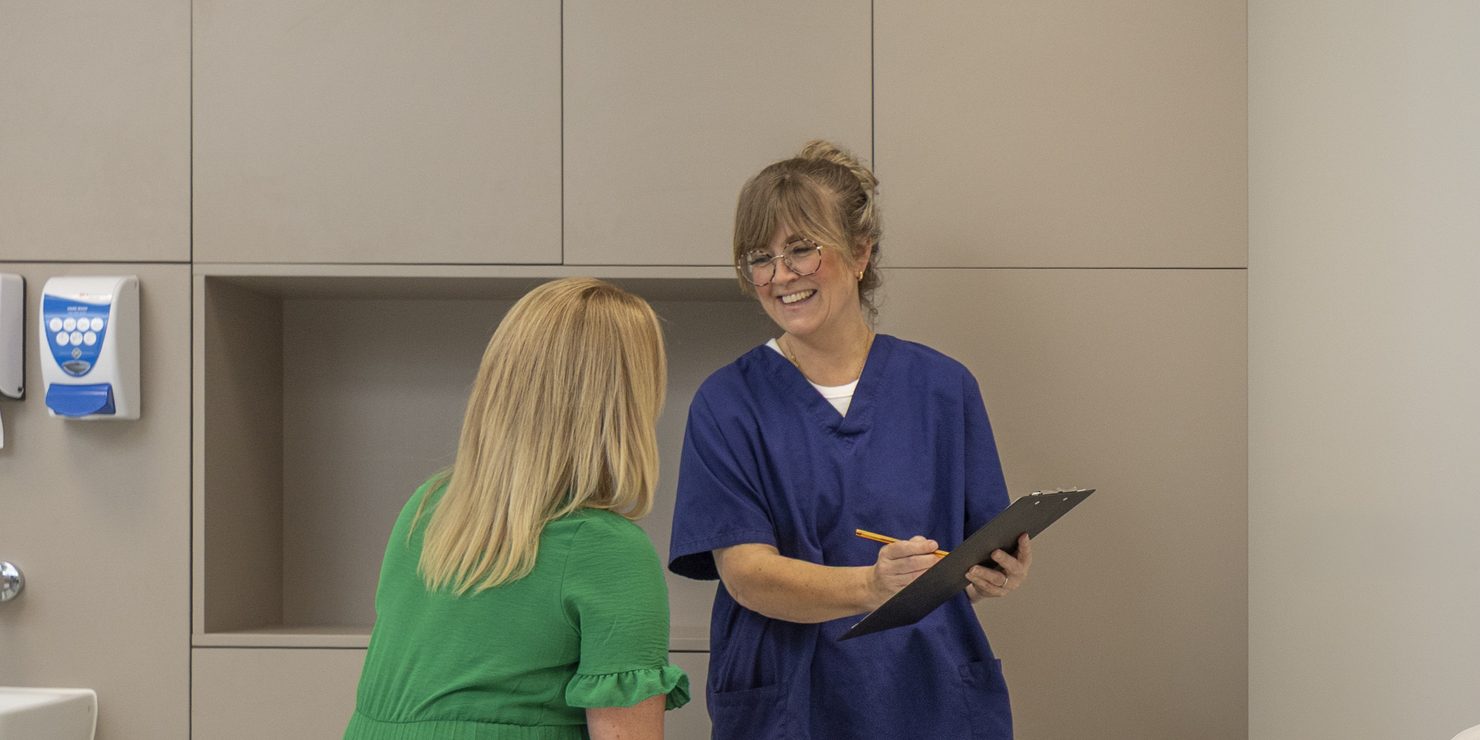
The consultation costs £200 and is face to face with the consultant plastic surgeon who would operate. Your surgeon examines you, tells you whether you need a mini or a full tummy tuck and whether your muscles need repairing, and explains what the recovery would mean for your job, your family and your plans. You then get one written price, and a second consultation before you decide is free.
You can book online or call the team on 0131 376 3785.
Questions patients ask
How long is recovery after a tummy tuck? After a full tummy tuck, most people are back at a desk job after two to three weeks and walk more upright by three to four weeks, with posture nearly normal by six. You stick to walking for six weeks, or three months after a muscle repair, and the final result shows at about six months. After a mini tummy tuck, most people return to desk work after one to two weeks.
How long will I be bent over after a tummy tuck? Without a muscle repair, most people stand straighter by two to three weeks. If your stomach muscles were tightened, it takes three to four weeks or longer, and posture is nearly normal by six weeks. Do not force it, because staying bent protects the repair.
When can I remove the tape after a tummy tuck? Paper tape comes off at the end of week two, and a little petroleum jelly helps if it sticks. Glue tape stays on until week three. Scar taping, with fresh paper tape, starts at about week five once the wounds have healed.
How do I clean my belly button after a tummy tuck? If your belly button was moved, clean it once a day with a cotton bud and warm soapy water. Gently lift away any crusting and pat it dry. Call us if redness spreads, if there is a smelly discharge, or if the pain is getting worse.
When can I have a bath after a tummy tuck? Showers are fine from day one. Baths wait until the wounds have fully healed, at least two weeks after a mini tummy tuck and about six weeks after a full one. Hot tubs wait with swimming: about six weeks after a mini tummy tuck, once healed, and about three months after a full one.
Do I need to wear a compression garment after a tummy tuck? The compression stockings are what you need, day and night until you are fully mobile, usually about three weeks. An abdominal garment is optional. If you wear one, it must never feel tight.
When can I drink alcohol after a tummy tuck? Wait three weeks after either a mini or a full tummy tuck.
Will I have drains after a tummy tuck? Probably not. We rarely use drains, so most people go home without one.

Ready to talk it through?
Book a consultation online, call the team, or send us a question first.