Lipoma removal in Edinburgh
A lipoma is a soft, harmless fatty lump under the skin, removed when it grows, becomes uncomfortable or shows. The consultant who assesses you removes it completely under local anaesthetic, and the tissue goes for histology to confirm the diagnosis.
- Hospital stay
- Outpatient day case
- Histology
- Included on every removal
- Recovery
- 0 to 1 week off work, longer for larger lipomas
- Guide price
- From £695 (under 2cm) to £2,500 (over 5cm). Full price list below
- First appointment
- Typically within 1 to 2 weeks
- GP referral
- Not required
- Your consultants

Contents
What lipomas are
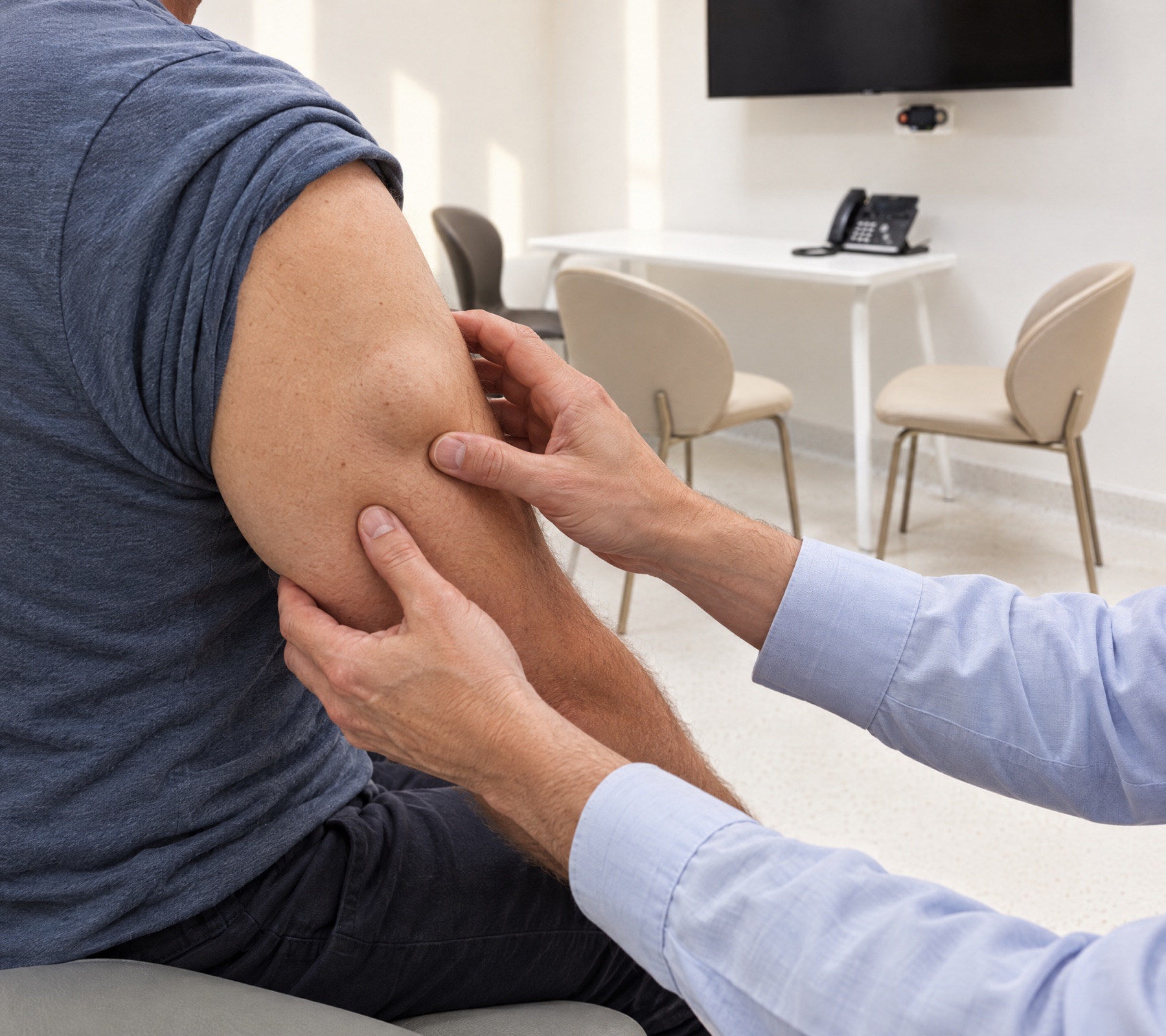
A lipoma is a benign tumour of mature fat cells — soft, mobile, slow-growing and painless in almost all cases. It is the most common soft-tissue lump of adulthood, found most often on the trunk, neck, upper arms and thighs. The soft, easily moved consistency is what tells a consultant the lump is most likely a lipoma. Some patients have multiple lipomas, which can occasionally run in families.

How lipoma removal is performed
The method is chosen at consultation, based on the size, site, and depth of the lipoma.
Surgical excision — the standard treatment. A small incision is made over the lipoma, the lipoma is dissected free from the surrounding tissue, and the wound is closed with sutures in two layers (deep and skin) to support healing. The incision length is typically a little shorter than the diameter of the lipoma. The excised lipoma is sent for histology in every case.
Minimal-incision technique — for smaller, soft lipomas in cosmetically sensitive sites, a shorter incision can sometimes be used. The lipoma is extracted through the smaller wound with careful technique. Suitable only for selected lipomas; not appropriate for larger or firmer lipomas, which require a full excision to remove cleanly.
Larger lipomas (over 5cm), deeper lipomas (under fascia or within muscle), and lipomas in anatomically challenging sites are planned under sedation or general anaesthesia. Imaging (ultrasound or MRI) may be requested at consultation if the depth or extent of the lipoma is not clear from clinical examination.
Histology is performed on every excised lipoma. While the vast majority of fatty soft-tissue lumps are benign lipomas, a small proportion are atypical lipomatous tumours or, very rarely, liposarcomas. Histology confirms the diagnosis.
When to seek removal
Patients commonly book lipoma removal when one of the following applies:
- The lipoma is enlarging
- The lipoma has become uncomfortable — for example pressing against a bra strap, belt, or joint
- The lipoma is in a visible site and cosmetically bothersome
- Multiple lipomas are present and the patient would like a definitive plan
- A lump is felt that the patient wants identified and removed in a single pathway
Some features should prompt earlier assessment: rapid growth over weeks, increasing firmness, fixation to deeper tissues, or pain. These are uncommon in lipomas but are the features that distinguish atypical fatty tumours, and your consultant will discuss further investigation where appropriate.
What lipoma removal can and can’t do
Removing a lipoma takes away the lump and tells you for certain what it was. It leaves a scar, and it cannot stop new lipomas forming.
It can
- Remove the whole lipoma in one visit, under local anaesthetic for most, with the tissue sent for histology.
- Relieve pressure on a bra strap, belt or joint, or take away a visible lump.
- Use a shorter incision for some small, soft lipomas in visible sites.
- Arrange a scan first where the depth or extent is unclear.
- Occasionally remove a large, soft lipoma by liposuction through a small cut, which leaves a shorter scar but is more likely to come back than cutting it out.
It can’t
- Be done without a scar. The scar is usually a little shorter than the lipoma was wide and is placed along the skin lines where possible.
- Promise it will not come back. Recurrence is uncommon after a complete excision, and more likely after a minimal-incision removal, where some tissue can be left.
- Stop new lipomas. Some people form several over the years, and in some families it runs in the genes.
- Tell you what it is before histology. Almost all are benign lipomas, but a small number are atypical fatty tumours and, very rarely, a liposarcoma. The microscope decides.
- Always be done under local anaesthetic. Large, deep or awkwardly placed lipomas are planned under sedation or general anaesthesia.
Your consultant will tell you at your consultation which of these apply to you.
Risks, and how often they happen
Every procedure carries risk. Here they are in three groups, with how often they happen where the evidence allows. Your consultant will go through them with you, and they are in your written consent.
Expected Almost everyone, and they settle
-
A scar, a little shorter than the lipoma was wide, placed along the skin lines where possible. It is red or pink at first and fades over 12 to 18 months.
-
Swelling and bruising around the wound for the first one to two weeks.
-
Discomfort for a day or two, eased by simple painkillers.
-
Numbness or altered sensation around the scar, which usually settles over weeks to months and occasionally persists.
-
A dip in the contour where a large lipoma was, which usually softens as the tissues settle.
Uncommon Some patients, and some need further treatment
-
A fluid collection (seroma) in the space a large lipoma leaves, which may need draining with a needle.Uncommonlarger lipomas; no reliable figure
-
Wound infection that needs a course of antibiotics.Under 1 in 50higher on the lower leg and in the groin
-
Bleeding after surgery that needs pressure, a dressing change or a return to have the wound checked.Under 1 in 100a haematoma is more likely in a large cavity
-
The lipoma coming back, because some tissue was left, more likely after minimal-incision removal. It can be removed again.Uncommonno reliable figure for standard excision
-
A raised, thickened scar (hypertrophic or keloid), more likely on the chest, shoulders, upper back and earlobes and in darker skin. It can be treated but not always fully flattened.Uncommonno reliable figure
Rare but serious
-
A histology surprise: an atypical fatty tumour or, very rarely, a liposarcoma. Your consultant discusses it in person and refers you into the NHS sarcoma pathway.Rareno reliable figure
-
Injury to a nerve beneath the skin in the neck, around the elbow or at the wrist, which can cause lasting numbness or, rarely, weakness of a nearby muscle. Your consultant plans around the known danger zones.Rareno reliable figure
-
A serious reaction to the local anaesthetic.Very rare
-
A serious reaction to a general anaesthetic, where one is used for a large or deep lipoma.Very raregeneral anaesthetic cases only
For the long term
-
New lipomas can appear, and each is a separate decision. See your consultant about any lump that grows quickly, becomes firm or painful, or feels fixed.
-
Scars keep changing for a year or more. Protect a new scar from the sun for the first year, and tell us if it thickens.
-
Minimal-incision removal trades a shorter scar for a slightly higher chance of recurrence. Your consultant will say whether your lipoma is suitable.
Where these figures come from
- British Association of Dermatologists, Lipoma patient leaflet (Jun 2024). For: Histology surprise.
- NHS, Lipoma (reviewed Jul 2023). For: When lipomas are removed.
- Han et al., Biomed Res Int 2014;2014:867689. For: Recurrence after excision.
- Dixon et al., Dermatol Surg 2006;32:819-826 (5,091 lesions, no prophylactic antibiotics). For: Wound infection.
- Dixon et al., Br J Surg 2007;94:1356-1360 (5,950 skin cancer excisions). For: Bleeding after surgery.
- British Association of Dermatologists, Keloids patient leaflet (Apr 2021). For: Raised (hypertrophic or keloid) scars.
- NHS, Local anaesthetic (reviewed Dec 2025). For: Serious reaction to local anaesthetic.
- West Suffolk NHS Foundation Trust, Risks associated with your anaesthetic: anaphylaxis (source: Royal College of Anaesthetists). For: Anaphylaxis under general anaesthetic.
- Worcestershire Acute Hospitals NHS Trust patient leaflet. For: Death under anaesthetic.
Figures are drawn from UK national guidance and published studies, and your own risk may be higher or lower. More from the British Association of Dermatologists on lipomas and from the NHS on lipomas.
Aftercare
Wound care advice is provided in writing on the day of the procedure. Stitches are removed at 7 to 14 days, depending on the site. The Waterfront nursing team is available for the first week for any wound-related concerns. Your consultant remains accessible after the procedure — if anything concerns you, they will respond directly and arrange to see you as soon as needed.
Histology results are normally available within approximately two weeks and are communicated by the consultant who performed the procedure.
- Day of surgeryHome within the hour. Most skin surgery is under local anaesthetic.
- Next dayBack to office work. Heavy, dirty or wet jobs need a few days.
- Days 7–14Stitches out at Waterfront.
- 3–4 weeksHistology results, where a sample is sent to the laboratory.
- 12 monthsNurse reviews, dressing clinics and the treatment of any complications are included.
Typical timings. Your consultant and nurse will tailor them to you.

Your consultants
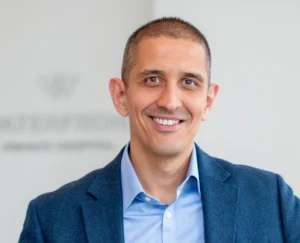
Lipoma removal at Waterfront is performed by Mr Ben Aldridge — the UK’s only consultant dual-qualified in dermatology and plastic surgery — and by Mr Kazem Nassar, consultant plastic and reconstructive surgeon. Both are on the GMC Specialist Register. The consultant who assesses you is the consultant who performs the removal and reviews you afterwards.
You meet your consultant at your first appointment. The same consultant plans your treatment, carries it out and sees you afterwards.


What lipoma removal costs
- Consultation
- £200, with a consultant. It includes a dermoscopic examination and a same-appointment recommendation.
- Histology
- Included with every excision, so you get a laboratory diagnosis, not just a removal.
- Your quotation
- Confirmed in writing after your consultation, once the consultant has assessed the lesion.
- Paying
- Interest-free finance over 6 or 10 months is available for most skin procedures at Waterfront.
Pricing depends on the size, depth, and site of the lipoma. Guide prices at Waterfront Private Hospital:
- Consultation — £200
- Removal of a small lipoma (under 2cm) — from £695
- Removal of a medium lipoma — from £895
- Removal of a large lipoma (over 5cm) — £1,195 to £2,500
- Cases requiring sedation or general anaesthesia — priced after assessment
Each price covers the consultant’s fee, the hospital and theatre fees at Waterfront, histology, and routine post-operative reviews. Final pricing is confirmed in writing after consultation, based on the size, site, depth, and method required.
Waterfront Private Hospital is self-pay.

Frequently asked questions about lipoma removal
Who performs lipoma removal at Waterfront?
Do I need a GP referral?
How quickly can I be seen?
What anaesthetic is used?
Is the lipoma sent for histology?
Will the procedure leave a scar?
What is minimal-incision removal and when is it suitable?
What is the recurrence risk?
Can multiple lipomas be removed in one session?
What if my lipoma is growing quickly or feels different from my other lumps?
Are multiple lipomas a sign of something more serious?
How is treatment paid for?
Written by

Mr Kazem Nassar, MBChB, FRCS (Plast), GMC 7131999, is a Plastic and Reconstructive Surgeon Consultant with over 10 years of experience. He practices at St John’s Hospital and the Western General Hospital in Edinburgh, specialising in melanoma, skin cancer treatments, breast surgery, and post-cancer reconstructive surgery.
